
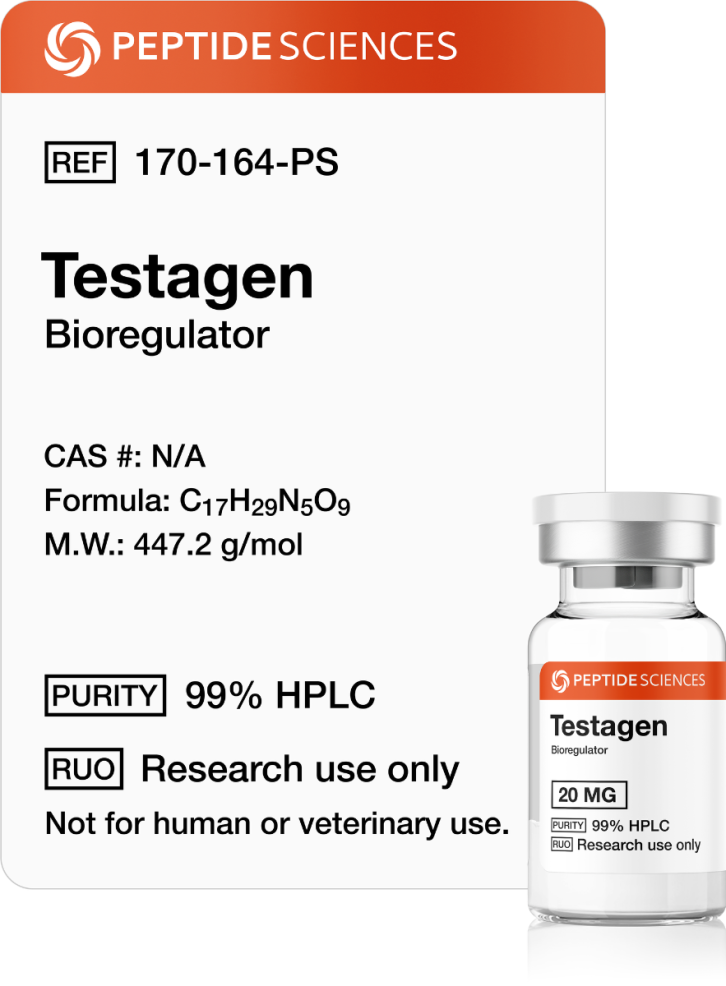
What is Testagen?
Testagen is a short-chain peptide bioregulator (tetrapeptide) with the amino acid sequence:
- Lysine (Lys)
- Glutamic acid (Glu)
- Aspartic acid (Asp)
- Glycine (Gly)
It’s often abbreviated as KEDG and belongs to the Khavinson bioregulator peptide family developed in Russian longevity and endocrine research programs. (Peptide Tech)
👉 Unlike typical peptides that stimulate hormones directly, Testagen is studied for its ability to influence gene expression in specific tissues.
What does Testagen do? (research context)
Testagen is primarily associated with the male reproductive system and endocrine signaling.
Research suggests it may:
1. Support testicular cell function
- Studied in Leydig and Sertoli cell activity
- Linked to spermatogenesis and tissue signaling (Peptides.GG)
2. Influence testosterone pathways
- May help regulate communication in the hypothalamic–pituitary–gonadal (HPG) axis
- Associated with testosterone biosynthesis in research models (Peptide Database)
3. Modulate gene expression
- Interacts with DNA regulatory regions
- Influences cellular repair and endocrine signaling (Peptide Tech)
4. Affect pituitary–thyroid signaling
- Some studies suggest interaction with pituitary hormone pathways (TSH, T3, T4) (Peptide Gurus)
What “Testagen 20mg” actually means
When you see:
👉 “Testagen 20mg”
It typically refers to:
- A lyophilized (freeze-dried) peptide vial
- Total peptide content = 20 milligrams
- Intended for laboratory research use only
Most suppliers clearly state:
“For research use only. Not for human consumption.” (Peptides.GG)
⚠️ Important:
- This is not a standardized dose
- Not a medical or consumer product
How it’s studied (research areas)
Testagen is mainly investigated in:
• Endocrine system research
- Hormonal signaling pathways
- Pituitary–gonadal axis regulation
• Male reproductive biology
- Spermatogenesis
- Testicular cell metabolism
• Aging & longevity research
- Age-related decline in hormone signaling
- Cellular repair in endocrine tissues
• Gene regulation studies
- Epigenetic influence on endocrine cells
What the science says (limitations)
Here’s the reality:
- Most data is preclinical (lab/animal models)
- Limited large-scale human trials
- Mechanisms are still being explored
Even research sources emphasize it is used for:
👉 “laboratory-based research… not consumption” (Peptide Tech)
Why Testagen is trending
Search demand is driven by:
- Testosterone optimization discussions
- Anti-aging / longevity communities
- Interest in bioregulator peptides
- Biohacking forums
From Reddit discussions:
“Testagen… targets testicular tissue and hormonal signaling” (Reddit)
⚠️ These are anecdotal and not clinical evidence—but they explain the growing interest.
Risks of “Testagen 20mg” products
Products sold online may involve:
- Non-regulated manufacturing
- Inconsistent purity
- Mislabeling
- No sterility or clinical validation
Even high-purity claims do not mean medical-grade safety.
Important clarification about “20mg”
This is one of the biggest misunderstandings:
👉 “20mg Testagen” = total vial content
👉 NOT = recommended dose
👉 NOT = approved therapy
SEO strategy (very important for you)
To rank safely, avoid:
Instead use:
- “Testagen 20mg: What It Is and How It Works”
- “Testagen Bioregulator Explained (Benefits & Mechanism)”
- “Testagen vs Thymogen vs Vilon”
This lets you:
- Rank for high-intent keywords
- Avoid Google/ad policy issues
- Build authority in peptide + longevity niches
Bottom line
Testagen is a research peptide bioregulator targeting reproductive and endocrine systems, studied for gene regulation and hormonal signaling. However, “Testagen 20mg” refers only to a research-grade quantity—not an approved or consumer-ready product.
If you want, I can next:
- Build a bioregulator comparison hub (Testagen vs Vesugen vs Vilon)
- Or create a complete peptide SEO cluster strategy to rank your site fast
Reviews
There are no reviews yet.