
What Are These Peptides?
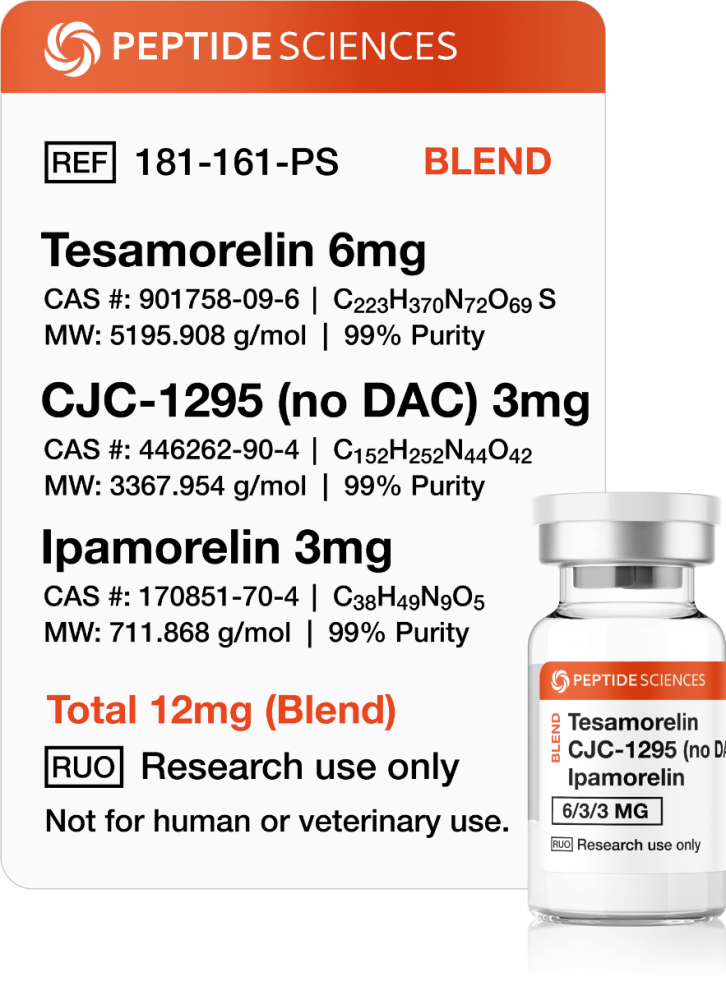
1. Tesamorelin
Tesamorelin is a synthetic GHRH analog that stimulates the pituitary gland to release growth hormone.
- Originally approved for HIV-associated lipodystrophy
- Increases IGF-1 levels
- Works in a more physiological, regulated pattern
2. CJC-1295 (No DAC)
CJC-1295 without DAC is a short-acting GHRH analog.
- Stimulates natural GH pulses
- Short half-life (minutes to hours)
- Often used in research to mimic natural hormone rhythms
(With DAC is long-acting, but “no DAC” behaves very differently.)
3. Ipamorelin
Ipamorelin is a GHRP (growth hormone releasing peptide).
- Activates ghrelin receptors
- Triggers GH release without strong effects on cortisol or prolactin
- Known for being more selective and “cleaner” than older GHRPs
Why These Are Blended Together
A blend like Tesamorelin + CJC-1295 (no DAC) + Ipamorelin is discussed because it targets two complementary pathways:
Dual stimulation approach:
- GHRH pathway → Tesamorelin & CJC-1295
- Ghrelin pathway → Ipamorelin
👉 This combination may (in research contexts):
- Increase total GH output
- Enhance pulsatile release patterns
- Support IGF-1 production
What “12mg Blend” Means
The label “12mg blend” typically refers to:
- Total peptide content in a vial
- Not a single dose
- Not a standardized clinical formulation
There is no approved medical product combining these peptides in a fixed blend like this.
Regulatory Status (Important)
All three compounds have strict limitations:
- Tesamorelin → prescription-only (specific medical use)
- CJC-1295 (no DAC) → research-use only
- Ipamorelin → research-use only
Safety Considerations
Because blends like this are not clinically approved, there are major unknowns:
- No standardized dosing guidelines
- No large-scale human safety studies
- Unknown interaction effects between peptides
- Risk of hormone imbalance
Potential effects discussed in research include:
- Changes in IGF-1 levels
- Fluid retention
- Appetite changes
- Injection-related reactions (in research contexts)
Risks of Online “Blend” Products
Products marketed as peptide blends may involve:
- Incorrect peptide ratios
- Mislabeling of total vs active dose
- Low purity or contamination
- Non-sterile production
- No medical oversight
Even if labeled “research grade,” they are not equivalent to regulated medications.
Why This Stack Is Popular
Search demand is driven by:
- Bodybuilding and performance communities
- Interest in GH optimization
- Anti-aging and recovery discussions
- Biohacking trends
The idea is to maximize GH release through multiple pathways, but this remains largely experimental.
SEO Strategy Tip (Very Important)
To rank for this keyword safely, avoid:
Instead use:
- “Tesamorelin vs CJC-1295 vs Ipamorelin: Full Comparison”
- “GH Peptide Stack Explained (Mechanism & Safety)”
- “CJC-1295 + Ipamorelin Benefits and Risks”
This helps you:
- Capture high-intent traffic
- Avoid policy violations
- Build authority in peptide content
Bottom Line
Tesamorelin, CJC-1295 (no DAC), and Ipamorelin are growth hormone–related peptides with different mechanisms, sometimes discussed together in research contexts. However, blended products are not medically approved, not standardized, and carry significant uncertainty in safety and dosing.
If you want, I can next:
- Write a full 859-word SEO landing page (USA/UK optimized)
- Create a “GH peptides stack guide” (high-ranking article)
- Or build a complete peptide SEO cluster to grow your traffic fast
Reviews
There are no reviews yet.