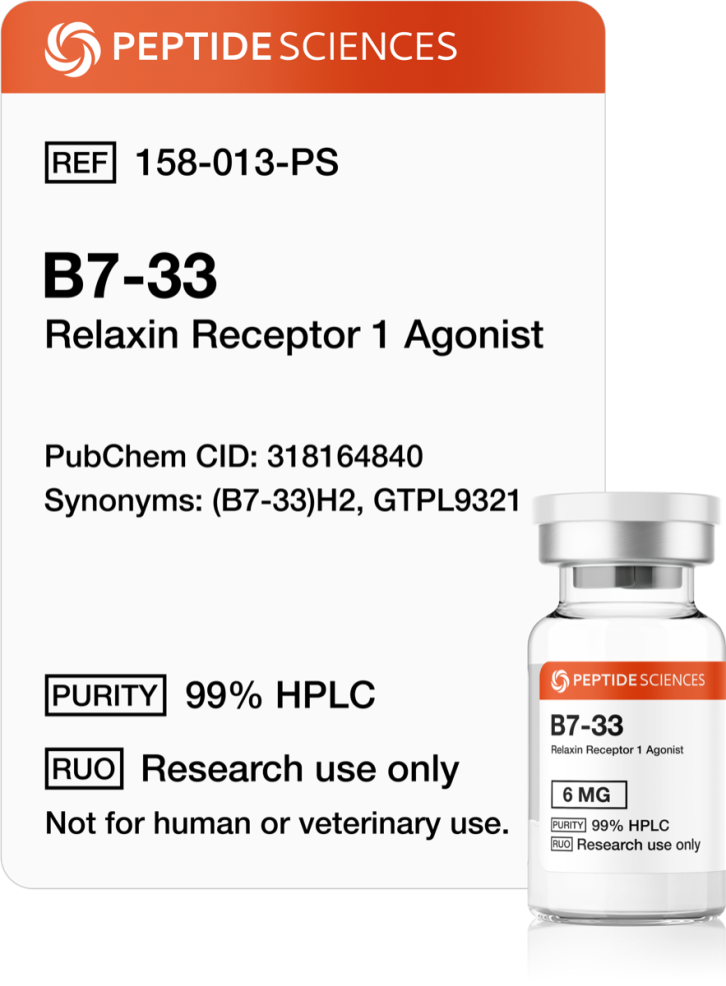
B7-33 6mg

$70.00

& Free Shipping

B7-33 is a synthetic single-chain peptide derived from the human H2-relaxin protein and is studied as a functionally selective agonist of the RXFP1 receptor. B7-33 peptide research focuses on how this relaxin-2–derived analogue influences extracellular matrix (ECM) remodeling pathways under controlled laboratory conditions, including signaling associated with ERK1/2 phosphorylation and regulation of matrix metalloproteinases. Compared with full-length relaxin-2, B7-33 is investigated for receptor-biased signaling profiles that can be used to probe specific downstream mechanisms.

In vitro assays and animal models commonly examine changes in collagen deposition markers, ECM turnover enzymes (e.g., MMP-2), and fibroblast activation signatures. Major research areas include fibrosis-relevant pathway biology, vascular endothelium signaling and tone regulation in preclinical systems, and biomaterials research where local tissue responses to implanted surfaces are measured. These systems matter in laboratory research because they provide measurable endpoints for studying tissue remodeling, cellular signaling, and ECM organization without implying clinical effectiveness or human use.

For research use only. Not for human consumption.

References:
Hossain MA et al., Chem Sci, 2016 7(6):3805–3813
Chan LJ et al., Br J Pharmacol, 2012 165(8):2612–2626
Bathgate RAD et al., Front Endocrinol (Lausanne), 2013 4:13

Category:

B7-33 6 mg is a synthetic peptide fragment based on a specific segment of the human H2-relaxin protein, engineered to selectively activate the relaxin family peptide receptor 1 (RXFP1) with a bias toward beneficial signalling pathways. Unlike full-length relaxin, which engages multiple intracellular cascades, B7-33 preferentially stimulates the extracellular signal-regulated kinase 1/2 (ERK1/2) pathway and increases the expression of matrix metalloproteinase-2 (MMP-2), an enzyme involved in breaking down excess collagen in the extracellular matrix. This mechanism has made B7-33 of interest in laboratory and preclinical research focused on fibrosis, tissue remodelling, and cardiovascular effects, such as reducing scarring after myocardial injury or attenuating fibrotic encapsulation around implants in animal models.

Despite promising outcomes in experimental systems, B7-33 remains a research compound and is sold strictly for laboratory use, not approved by major regulatory bodies like the U.S. Food and Drug Administration for human therapeutic use. Evidence in humans is minimal, and most available data come from in-vitro or animal studies investigating its effects on fibrosis, extracellular matrix regulation, and cardiovascular signalling. As a result, B7-33 should not be considered a medical treatment, and any exploration of its biological properties should be confined to qualified research settings with proper oversight.


Reviews

There are no reviews yet.

Be the first to review “B7-33 6mg”

Your email address will not be published. Required fields are marked *

Shopping Cart